Welding can offer something increasingly valuable in today’s job market: a career path where your earning potential can rise substantially as your skills improve.
A new welder may begin with basic fabrication or production work, but that does not have to be where the career ends. Welders can progress into structural welding, pipe welding, specialized TIG work, industrial maintenance, supervision, inspection, automation, and even business ownership.
>>> See our full list of courses here. <<<
And the economic environment may make those skills even more valuable in the years ahead.
The United States is facing a significant need for new welding professionals as experienced workers retire and employers struggle to replace them. The American Welding Society (AWS) estimates that the country will need approximately 320,500 new welding professionals by 2029. AWS has also reported that more than 157,000 welding professionals are approaching retirement.
For people considering a skilled trade, that combination of retirements and workforce demand creates an important opportunity.
The more welding skills you develop, the more valuable you may become to employers—and the higher your potential welding salary can climb.
How Much Do Welders Make?
According to the U.S. Bureau of Labor Statistics, the median annual wage for welders, cutters, solderers, and brazers was $53,750 in May 2025. That works out to roughly $25.84 per hour for a full-time worker.
But the median does not tell the entire story.
The lowest 10% of workers in the occupation earned less than $39,240 per year, while the highest 10% earned more than $77,530 per year. BLS specifically notes that welding wages vary based on experience, skill level, industry, and employer.
That distinction is important.
There is no single “welder salary.”
Someone performing basic production welding in their first year is in a very different position from an experienced welder who can successfully complete difficult code-quality welds in the field.
Location, certifications, overtime, union agreements, travel, per diem, industry, shift differentials, and the difficulty of the work can all affect total compensation.
Think of welding as a ladder.
As your capabilities increase, you can become qualified for jobs that fewer people can perform.
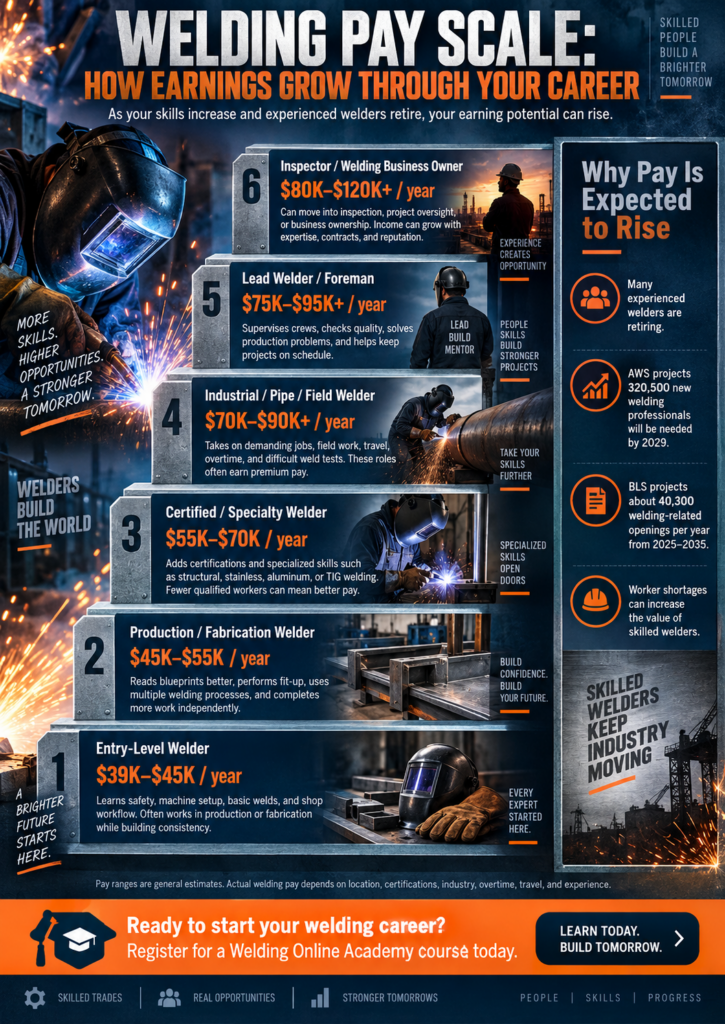
Level 1: Entry-Level Welder
Typical career stage: 0–2 years
The first step on the welding pay scale is usually an entry-level position.
Beginning welders may work in manufacturing plants, fabrication shops, repair facilities, construction operations, or production environments. They may perform repetitive welds, prepare materials, grind finished welds, tack components, assist experienced welders, and learn to work from basic drawings and welding symbols.
At this stage, an employer is paying partly for your labor and partly for your potential.
Your goal should be to become dependable.
An entry-level welder who can consistently produce acceptable welds, follow safety procedures, arrive on time, and learn new processes can quickly become more valuable.
Based on current national wage data, workers near the lower end of the occupation may earn around the upper-$30,000s to $40,000s annually, although actual starting wages vary substantially by region and employer.
The key is not to view that starting wage as your ceiling.
It is the first rung of the ladder.
Level 2: Experienced Production or Fabrication Welder
Typical career stage: 2–5 years
Once a welder has accumulated practical experience, the focus begins shifting from simply knowing how to weld to being able to weld accurately, efficiently, and independently.
Experienced fabrication welders may become proficient in several processes, including:
- MIG/GMAW
- TIG/GTAW
- Stick/SMAW
- Flux-cored/FCAW
- Cutting and gouging
- Blueprint and welding-symbol interpretation
- Fit-up and fabrication
This is where many welders begin approaching or exceeding the national median.
The BLS reported a $53,750 median annual wage for the overall welding occupation in 2025. In specialty trade contracting, however, the median was higher at approximately $59,440 annually.
Experience creates leverage.
Employers do not simply need someone capable of striking an arc. They need people who can read the job, prepare it correctly, minimize defects, maintain production speed, and solve problems without constant supervision.
Those abilities can translate directly into higher pay.
Level 3: Certified and Specialized Welder
Typical career stage: 3–8+ years
Specialization is where the welding pay scale can become much more interesting.
The more technically difficult the job, the smaller the pool of people capable of performing it successfully.
Welders may specialize in areas such as:
- Structural steel
- Pipe welding
- Stainless steel
- Aluminum
- Pressure vessels
- Industrial construction
- Shipbuilding
- Aerospace-related fabrication
- Energy infrastructure
- Heavy equipment
- Sanitary welding
- Code-qualified welding
A welder who can pass demanding qualification tests and repeatedly produce high-quality work may have access to opportunities that basic production welders do not.
This is one reason the highest 10% of welders in BLS data earned more than $77,530 annually in 2025.
Certain specialized positions can potentially produce much higher total earnings once overtime, travel, shift premiums, or per diem are included. Those amounts vary tremendously, however, so advertisements promising that every welder will automatically earn six figures should be treated cautiously.
Six-figure welding incomes are possible.
They are not guaranteed.
They are generally associated with some combination of advanced skills, difficult environments, overtime, travel, specialized industries, certifications, or leadership responsibilities.
Level 4: Industrial, Field, and Advanced Welding Careers
Experienced welders may eventually move toward large industrial projects where downtime is extremely expensive.
Factories, power-generation facilities, transportation systems, shipyards, infrastructure projects, heavy equipment operations, and industrial plants all depend on skilled workers who can fabricate and repair metal components correctly.
That responsibility has economic value.
AWS describes welding as foundational to industries including advanced manufacturing, aerospace, energy, shipbuilding, military applications, oil and gas, automotive production, steel construction, food and beverage manufacturing, and medical and pharmaceutical operations.
When an experienced welding professional is required to keep a project moving, the cost of not having that worker can become greater than the worker’s wages.
That is one reason shortages matter.
Scarcity can increase the negotiating power of qualified workers, particularly for positions requiring experience that cannot be created overnight.
Level 5: Welding Supervisor, Foreman, or Shop Leader
Not every experienced welder needs to spend an entire career under the hood.
Some advance into leadership.
A welding supervisor or fabrication foreman may oversee crews, assign work, monitor productivity, interpret drawings, coordinate materials, enforce safety requirements, troubleshoot problems, and help ensure completed work meets specifications.
Supervision creates another path toward higher earnings because the employee is now responsible for the productivity of an entire team.
As one reference point, BLS data for fabricated metal product manufacturing shows a 2025 median wage of approximately $73,910 for first-line supervisors of production and operating workers.
That is not specifically a “welder salary,” and individual welding supervisors may earn more or less, but it demonstrates how moving from production work into leadership can change someone’s earning potential.
Level 6: Welding Inspector and Technical Specialist
Another progression route is inspection and quality control.
Experienced welders who understand welding procedures, discontinuities, codes, documentation, and quality requirements may eventually pursue careers involving welding inspection.
Instead of producing every weld themselves, these professionals help determine whether completed work meets applicable requirements.
The value of experience becomes especially obvious here.
Someone who has spent years actually welding often has practical knowledge that is difficult to teach exclusively from a textbook.
Advanced welding professionals may also move toward:
- Quality assurance
- Welding coordination
- Procedure development
- Welding instruction
- Robotic welding
- Automation
- Technical sales
- Project management
Automation does not necessarily eliminate the opportunity.
It changes the skill set.
AWS has noted that the shortage of traditional welding professionals is helping encourage greater adoption of robotic welding while simultaneously creating demand for people capable of programming, operating, troubleshooting, and maintaining automated welding systems.
The welder of the future may need to understand both the arc and the machine controlling it.
Level 7: Welding Business Owner
The highest ceiling in welding may ultimately come from ownership.
Experienced welders sometimes build businesses around services such as:
- Mobile welding
- Equipment repair
- Structural fabrication
- Commercial welding
- Industrial maintenance
- Custom metal fabrication
- Railings and stairs
- Agricultural repair
- Trailer fabrication and repair
- Contract welding
At this point, your income is no longer tied exclusively to the number of hours you personally weld.
You may own the equipment, employ other welders, bid contracts, manage projects, and build a customer base.
Of course, business ownership comes with risk. There are expenses, insurance requirements, taxes, equipment costs, customer acquisition challenges, and responsibilities that employees do not have.
But it also demonstrates why welding should be viewed as more than one occupation.
It is a skill that can become the foundation of an entire career or business.
America’s Welding Shortage Could Make Skilled Welders More Valuable
The long-term workforce numbers are particularly important for anyone entering welding today.
AWS estimates that the United States will need 320,500 new welding professionals through 2029, or roughly 80,000 positions to be filled annually during that period. AWS has reported that more than 20% of the welding workforce is nearing retirement while fewer than 10% of welders are under age 25.
The Bureau of Labor Statistics approaches the workforce from a somewhat different methodology but points to the same replacement problem.
BLS projects approximately 40,300 openings for welders, cutters, solderers, and brazers every year from 2025 through 2035, even though total employment in the occupation is projected to grow only about 2%. Most of those openings are expected to come from workers leaving the occupation or exiting the labor force, including retirement.
That distinction matters.
America does not need welding employment to explode by 20% for there to be a labor problem.
Thousands of existing jobs must simply be filled as experienced workers retire.
Why Retirements Could Put Upward Pressure on Welding Pay
A shortage does not guarantee that every welding job will suddenly pay dramatically more.
Wages are influenced by location, industry conditions, productivity, contracts, economic cycles, and individual employers.
But basic economics still matters.
Imagine a fabrication company needs 30 experienced welders and can only find 20.
The company has several options.
It can postpone production.
They can turn away business.
It can invest in automation.
or, they can train inexperienced workers.
Or it can make its compensation package more attractive to recruit and retain experienced welders.
When multiple companies encounter the same problem, qualified workers gain bargaining power.
The effect can become even more significant at the higher levels of the welding profession.
Replacing an entry-level employee may take weeks.
Replacing someone with 20 years of fabrication experience, multiple qualifications, leadership abilities, and knowledge of specialized equipment can be considerably harder.
That experience is exactly what the industry is beginning to lose through retirement.
Your Welding Pay Scale Is Closely Connected to Your Skill Scale
One of the best ways to think about welding compensation is this:
Do not focus only on your hourly wage. Focus on increasing the number of welding problems you are qualified to solve.
A beginner may be able to perform one welding process in controlled conditions.
An experienced professional may understand multiple processes, metals, positions, blueprints, procedures, codes, fit-up requirements, inspection standards, and troubleshooting techniques.
Those two workers may both be called “welders.”
Their economic value is not the same.
As fewer experienced tradespeople remain in the workforce, workers who deliberately build those capabilities may be positioned to benefit.
Start Building Your Welding Career Today
The welding shortage presents an opportunity, but opportunity only matters if you have the skills required to take advantage of it.
Every experienced welder started by learning the fundamentals.
Whether your goal is to enter a fabrication shop, pursue structural welding, move toward TIG or pipe welding, eventually become an inspector, or build your own welding business, developing a strong foundation is the first step.
Welding Online Academy can help you begin that journey.
Our online welding courses are designed to help students understand the principles, terminology, safety practices, processes, and techniques behind professional welding.
The industry needs a new generation of skilled welding professionals. With hundreds of thousands of new professionals projected to be needed in the coming years, now is an excellent time to begin developing those skills.
Register for a Welding Online Academy course today and start building the knowledge that can take you from welding beginner to skilled professional.
The first step toward earning more in welding is becoming capable of doing more.
Start learning today with Welding Online Academy.